how-to
How to Get a Car Towed: A Step-by-Step Guide
September 20, 2026 · Editorial Team · 14 min read
Table of Contents
- What You'll Need Before Calling for a Tow
- How to Get a Car Towed Immediately: Step-by-Step
- Emergency Roadside Assistance Cost: What to Expect
- Private Property Towing Laws: What You Can and Can't Do
- Towing Service Arrival Time: How Fast Can You Get Help?
- Common Mistakes to Avoid When Getting a Car Towed
- Frequently Asked Questions
Last Updated: September 20, 2026
What You'll Need Before Calling for a Tow
Knowing how to get car towed starts with having the right information ready before you dial. A dispatcher who gets your location, vehicle details, and payment method in the first two minutes can send the closest truck immediately.
Here's what to have on hand:
- Your exact location, including cross streets, a landmark, or the parking lot name
- Vehicle make, model, color, and license plate number
- Whether the car rolls, steers, or has a locked wheel
- Your payment method and, if applicable, insurance claim number
- A phone number where you can be reached while waiting
How to Get a Car Towed Immediately: Step-by-Step
Getting a car towed immediately comes down to three things: reaching a licensed operator, giving accurate details, and confirming the tow before the truck rolls. Most delays trace back to a missing detail, not a missing truck.
Step 1: Find a Licensed Towing Service
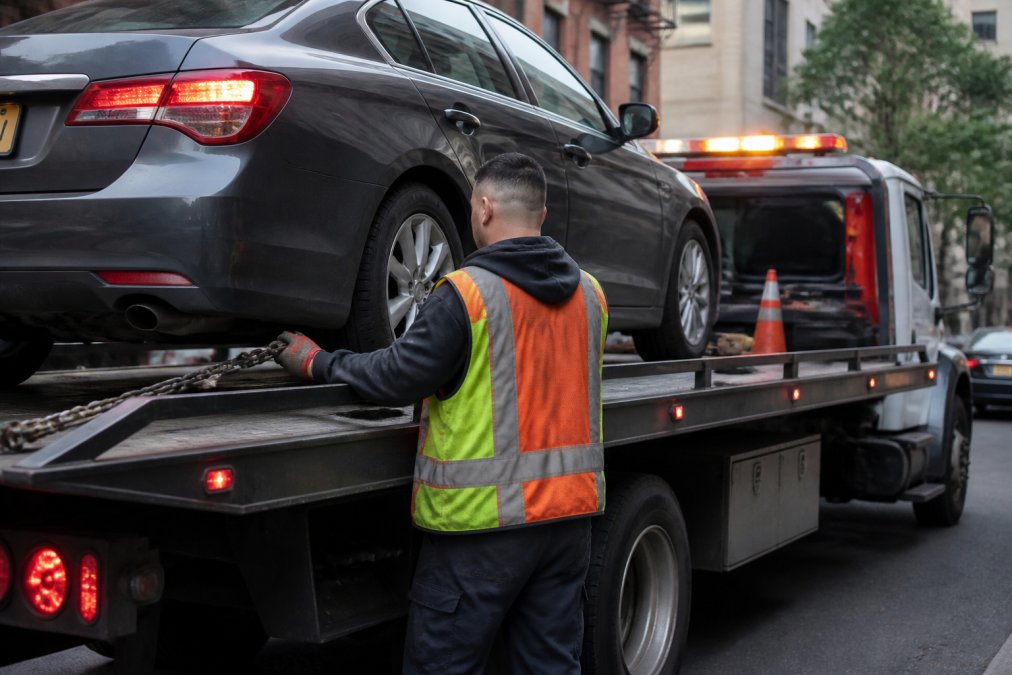
Call a licensed, insured towing company directly rather than a lead-generation number. Ask for the license number and confirm they carry liability coverage for damage during transport. A dispatcher who hesitates is a red flag.
Step 2: Provide Clear Vehicle and Location Details
Give the dispatcher your location, vehicle description, and the car's condition in one pass. Mention if the vehicle is trespassing on private property, blocking a driveway, or in a no parking zone, since those details change the hookup.
Step 3: Confirm the Tow and Payment Method
Confirm the destination before the truck moves: a repair shop, your home, or an impound lot. Ask for the tow fee, mileage charge, and payment methods accepted, and get the total in writing if you can.
Emergency Roadside Assistance Cost: What to Expect
Emergency roadside assistance cost depends on distance, vehicle type, time of day, and whether the tow is covered by insurance or a membership plan. There is no single flat rate, and any company quoting one before seeing your location is guessing.
| Cost Factor | What Drives It | How to Control It |
|---|---|---|
| Base hookup | Vehicle size and equipment needed | Confirm before dispatch |
| Per-mile rate | Distance to destination | Choose the nearest shop |
| After-hours surcharge | Time of day | Ask for the standard rate window |
| Storage fee | Days held at the lot | Retrieve the vehicle quickly |
| Administrative fee | Paperwork and release | Request an itemized receipt |
Private Property Towing Laws: What You Can and Can't Do
Private property towing laws are set at the state and municipal level, not by a single federal rule, so the answer to "can this car be towed from this lot?" depends on where the lot sits. Two things are almost always true: a property owner or their authorized agent can remove a trespassing vehicle, and that removal must follow posted-notice and authorization rules.
The three legal pillars of a private-property tow
Nearly every state towing statute is built on the same three requirements. If any one is missing, the tow can be challenged as wrongful.
- Proper signage. A no-parking or tow-away sign must be posted at every entrance and be visible from the parking space. Many states require it to list the towing company's name and phone number, the maximum tow and storage rate, and the hours the lot is enforced.
- Authorization. Only the property owner, a designated agent (like a lot manager), or a licensed towing operator acting on that authorization can order the tow. A random employee or competing business cannot.
- Licensed operator. The truck and driver must hold a current towing license and carry liability coverage. An unlicensed operator towing from private property exposes the property owner to liability.
What property owners can and cannot do
- Can: Post compliant signage, document the violation with timestamped photos, call a licensed towing service, and have the vehicle removed to a licensed storage facility.
- Cannot: Tow the vehicle themselves, block the trespassing car in, remove or damage the car, or tow without the required signage in place.
- Cannot: Tow a vehicle that is legally parked, even if the owner dislikes the driver. A valid permit, a paid meter, or an accessible-parking placard generally overrides a private lot's preference.
State-specific 'Towing Bill of Rights' protections
A growing number of states have passed what consumer advocates call a Towing Bill of Rights, typically giving owners:
- A cap on how much a towing company can charge for a private-property tow and for daily storage.
- A requirement that the tow company notify local law enforcement within a set time (often one to two hours) so the owner can locate the car.
- A right to pay by credit card, not cash only.
- A right to retrieve personal property from the vehicle before paying the tow bill.
- A right to a photo or written record of the vehicle's condition at the time of the tow.
- A short window (often 24 hours) to dispute the tow before storage fees escalate.
How to dispute a wrongful tow: step by step
If the tow happened without proper signage, without authorization, or with excessive fees, you have a process, not just a complaint.
- Document everything before you pay. Photograph the spot where the car was parked, the signage (or lack of it), and the vehicle's condition at the lot. Note the time, date, and who ordered the tow if you can find out.
- Request an itemized receipt. You are entitled to a breakdown of the tow fee, mileage, storage, and any administrative charge. Keep the original.
- File a complaint with the state regulator. Most states route towing complaints through the attorney general's consumer protection division, the state department of transportation, or a local consumer affairs office. File within the state's window, often 30 days.
- Send a written demand to the towing company. State the facts, cite the signage or authorization failure, and request a refund of the tow and storage fees. Send it certified mail for proof of delivery.
- Escalate to small claims court if needed. Most states set the small-claims limit high enough to cover a typical tow and storage bill. Filing fees are modest, and you do not need a lawyer.
- Report to local law enforcement if the tow may have been unauthorized. An unauthorized tow can be treated as a civil matter, but a police report creates a record that helps in court and with your insurer.
If you are the property owner
Post compliant signage before you ever need to tow, keep a log of violations with photos and timestamps, and use a licensed operator who provides a written authorization record. That paper trail protects you if the owner later claims the tow was illegal.
Towing Service Arrival Time: How Fast Can You Get Help?
Towing service arrival time is not a fixed number, it depends on how close the nearest available truck is, how clearly you described your location, and whether the operator can reach the vehicle once they arrive. Those variables are the difference between a 15-minute wait and a 90-minute one.
What actually drives the ETA
- Truck density. A metro area with dozens of licensed operators beats a rural route where the nearest truck is 40 miles out. Ask the dispatcher how many trucks are in service near you.
- Time of day. Rush hour, severe weather, and weekend nights push ETAs up because the same trucks handle more calls. A 20-minute average at 10 a.m. can become 60 minutes at 5:30 p.m.
- Access. A car in a surface lot is a five-minute hookup. A car in a low-clearance garage, behind a gate, or on a hill can add 15 to 30 minutes if the operator needs a different truck or a spotter.
- Vehicle condition. A car with a locked wheel, a flat tire, or a dead battery that won't shift out of park requires skates, a dolly, or a jump before the hookup starts.
How to shorten your wait
- Drop a pin, don't describe. Send the dispatcher a map pin or the exact address and cross street. "The corner by the deli" costs the driver minutes they cannot get back.
- State the access problem up front. Say "low-clearance garage, 6-foot-2 clearance" or "behind a locked gate, code 4417" on the first call. The dispatcher can send the right truck the first time.
- Confirm the vehicle rolls and steers. If it does not, say so. The operator may need a flatbed instead of a wheel-lift, which changes which truck is dispatched.
- Have payment ready. A dispatcher who knows you can pay by card on arrival does not have to call back to confirm, a common hidden delay.
- Ask for a live ETA and a callback. A company that tracks its drivers can give you a real number instead of a guess. If the truck is delayed, ask for a text update so you are not calling back every 10 minutes.
What to do while you wait
- If you are on a highway, move behind the barrier, stay in your vehicle with a seatbelt on, and turn on hazard lights. Do not stand in the roadway.
- If you are in a parking lot, stay in a well-lit area and keep your phone charged.
- If the car is being towed from private property, photograph the parking spot and any signage now, that evidence matters if you later dispute the tow.
- Remove electronics, cash, and personal items before the truck arrives.
When the ETA slips
If the truck is more than 15 minutes past the quoted window, call the dispatcher for a new estimate. If the company cannot give one, you may cancel and call another licensed operator, confirm there is no cancellation fee first.
Common Mistakes to Avoid When Getting a Car Towed
Most towing headaches come from small oversights, not bad luck. Avoiding these five mistakes saves time, money, and damage claims.
- Calling a random number from a search ad. Verify the company is licensed and insured before you agree to anything.
- Skipping the written estimate. Ask for the tow fee, mileage, and any surcharges in writing before dispatch.
- Leaving valuables in the car. Remove electronics, cash, and personal items before the vehicle is hooked up.
- Forgetting to photograph the car's condition. A quick walk-around with your phone protects you if a damage dispute arises.
- Ignoring where the car is going. Confirm the destination and get the lot's address and hours if it's being stored.
Here's a short checklist to run through at recovery:
- Photograph all four sides and the odometer before the tow
- Remove valuables and personal belongings
- Confirm the destination address in writing
- Keep the receipt and any release paperwork
- Inspect the vehicle for new damage before you drive off
Frequently Asked Questions
How much does it cost to get a car towed away?
The cost to get a car towed varies based on distance, vehicle type, and time of day. Emergency roadside assistance cost typically includes a base fee plus a per-mile charge. For exact pricing, contact a licensed towing service directly and ask for a written estimate before authorizing the tow.
Can anyone call to have a car towed from private property?
Private property towing laws vary by state and city. Generally, the property owner or an authorized agent can request a tow if proper signage is posted. However, some areas require law enforcement involvement. Always check local ordinances or consult a legal professional to avoid a wrongful tow claim.
What is the average arrival time for emergency towing?
Towing service arrival time depends on your location, traffic, and provider availability. In urban areas, many services aim for 15-25 minutes, but it can be longer during peak hours or severe weather. When you call, ask for an estimated arrival window and request a text or call when the driver is en route.
What information do I need to provide to a towing company?
Have your vehicle's make, model, color, license plate, and exact location ready. Also provide your name, phone number, and payment method. If the car is in a garage or lot, share the entry code or gate instructions. This helps the dispatcher send the right truck and avoid delays.
Need a tow right now?
BK Towing & Collision runs 24/7 across Brooklyn and Staten Island from 258 3rd Ave.
Call 929-606-6310